New Release
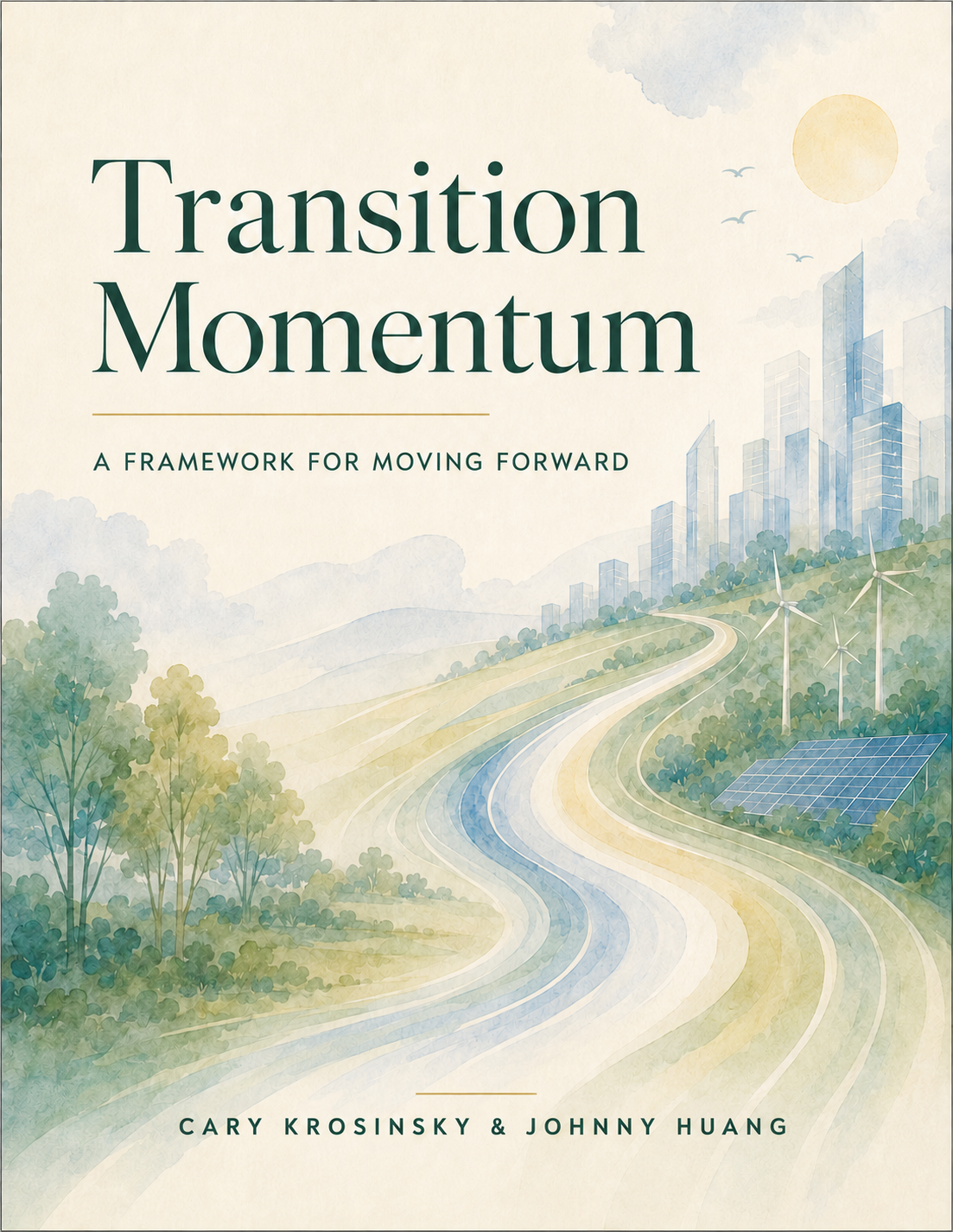
Transition Momentum
A newly published SFI Publishing title exploring how practical ideas, policy insight, and market action can accelerate the global transition to a more sustainable economy.
Overview
Why this book matters
Transition Momentum brings together informed perspectives on sustainability, sustainable finance, resilience, and climate technology in a format designed to help readers connect big-picture change with real-world decision-making.
Practical framing
Global relevance
Cross-sector insight
Actionable ideas
Appendix library
Book appendices
This section is designed to grow over time, with each appendix listed as a clear entry that can be expanded as new materials, notes, and supporting resources are added.
Appendix A — Contributors to Transition Momentum
Saaesha Bhimjiani is a student at NYU Stern studying Business & Political Economy and Philosophy. At SFI, she analyzed climate action plans of various pension funds to identify long-term portfolio decarbonization pathways and best practices for sustainable investment. She continues to pursue her interests in climate policy and sustainable business through her work in renewable energy advisory.
Kelly Cooper is a strategist, entrepreneur and researcher focused on why climate solutions scale—or don’t. Drawing on experience across investing, company-building and corporate advisory work, she examines the gap between innovation and scale: how market incentives, institutional decision-making and demand formation determine whether promising solutions achieve durable adoption and meaningful economic and environmental outcomes. She leads Sustainable Innovation Group and holds a master’s degree in Sustainability from Harvard University, where she supports graduate instruction in sustainable investing and energy decarbonization. Kelly is a contributing author to Trellis, which regularly publishes her original research and perspectives on building the markets and execution capacity required to move climate solutions from promise to widespread deployment.
Devika Gadhavi is a sustainability strategist focusing on the intersection of climate, finance, and healthcare. She is currently part of the Responsible Business & Sustainability team at BeOne Medicines, a global oncology pharmaceutical company, where her work spans sustainability reporting, investor ratings, climate regulation and disclosures, and carbon accounting.
She is also developing a financed emissions strategy for the Investment Office of a major healthcare system, helping translate climate risk into investment decision-making. Alongside this, she’s involved with Health in Climate (HiC), an accelerator uncovering the health costs of climate risk that current financial models tend to miss.
Previously, Devika helped shape The New York Times’ first media decarbonization strategy and supported The Rockefeller Foundation’s climate strategy through impact reporting and funder engagement at global convenings such as the UN General Assembly and COP. She holds a master’s degree from Harvard University, where her coursework spanned circular economics, sustainable investing, and AI governance. Across media, philanthropy, finance, and healthcare, Devika has come to see climate risk not as confined to any one industry, but as a shared responsibility that, when approached strategically, can drive real value for any business.
Geoff Moore is the Founder & CEO of Impactᴬᴺᴰ Inc., a Montreal-based company that acts as a placement agent, consultant and advisor on impact and sustainable investing for institutional investors. He is also the founder of the Pinned2Purpose Mental Health Initiative and is a strong proponent of the Global Brain Economy Initiative. Geoff was a speaker in 2025 and 2026 on Mental Health Day during the World Economic Forum in Davos. He has been active in and passionate about the impact investing space and other approaches to sustainable investing for over two decades and gave an extensive interview in Forbes on “The Potential of Impact Investing” in 2011.
Geoff has worked for over 30 years in the global asset management industry and has held senior institutional sales, client service and consultant relations roles throughout his career, the majority of which has been spent with the asset management divisions of the Bank of Ireland (BIAM), Deutsche Bank (DeAM), GE (GEAM) and State Street (SSGA). During this part of his career, Geoff held a variety of leadership roles including as Head of Canada for BIAM and DeAM; Member of the Executive Committee for the Americas with DB Advisors; Member of the Leadership Council with GE Canada, and Member of the Global ESG Working Group while at SSGA.
Geoff currently serves on the Board and the Investment and Risk Committee of the Inter-Generational Fund at Concordia University. He is a member of the Board of Directors with the Canada Forum for Impact Investment and Development (CAFIID, an Executive Ambassador with the REAL Mental Health Foundation, a Storyteller with Unsinkable and a member of the Board of Tennis for All Uganda. He has been a guest lecturer at McGill University and Harvard Extension School.
Given the polycrisis humanity is facing, 7 of 9 planetary boundaries now being breached, and the age of AI fast coming upon us with both hugely positive but also potentially catastrophic implications, Geoff believes that forward-looking paradigms for sustainable investing and overall prosperity need to build on the best of our existing investment approaches AND include a determined focus on opening up the adjacent possible, while considering a broader view of what true fiduciary duty means in support of both our financial well-being AND our overall well-being, which of course is dependent on our continued existence on a healthy planet.
Geoff is happy to connect with anyone who finds that his chapter in Transition Momentum resonates and can be reached through LinkedIn.
Simon Powell is Head of Research and Co-Founder of European Equity Research Partners (EERP), which produces issuer-funded institutional equity research across European markets, with particular depth in the underserved small and midcap sectors. He spent much of his career in thematic equity research, most recently as Global Head of Thematic Research at Jefferies in Hong Kong, where sustainability and the energy transition were central to his coverage. He has also held senior research roles with UBS and CLSA covering various sectors in Asia including utilities, and oil and gas. He has served as an Independent Non-Executive Director of an Oslo-listed producer of bio-based chemicals. Simon holds a BSc (Hons) in Biochemistry from the University of Sussex.
Sissi Wang is an incoming MSc Finance student at Imperial College Business School (Class of 2027) and a graduate of NYU Shanghai, where she studied Business and Finance with a minor in Mathematics. She is particularly interested in how investment decisions shape long-term economic growth and sustainable transition. Her experience across investment banking, strategy consulting, and equity research has further deepened her interest in connecting financial analysis with real-world impact.
Appendix B — Teaching sustainable finance in engaging ways
ESG is boring, yet sustainability and impact are exciting.
What I mean by this, is that if classes simply involve professors dictating what E, S and G are, across the many issues that present as potential risks and opportunities, and then go into evolving concepts such as materiality, standards, EU regulations and data, this to me anyway seems like a good cure for insomnia. Visit the Global Reporting Initiative if you want to know what ESG datapoints can be captured and reported. Visit the Global Impact Investing Network if you want good information on impact metrics and themes to potentially solve for. Use the internet to explore regulations and standards in process, but is this all effective let alone interesting?
That’s what our classes are, and in fact what this book has set out to be: an exploration of the work of the field of sustainable finance. A chance for students to explore what is and isn’t working and get their minds around what they might like to explore themselves in so far as solutions and their own careers.
So how do we make our classes fun, or at least try to?
Going back to 2009, when we were putting together our first class on the subject at Columbia University’s CERC unit of the Earth Institute, we believed a class should use as many methods as possible, including group projects, interactive lectures and guest speakers as well as videos, readings and related assignments and more. Not knowing how best to teach, I picked up a book on the subject, and it recommended this same sort of multi-dimensional approach, so I put that book down and got on with it.
Our classes evolved over time, and many have learned from our teaching methods and process, which we not only welcome but encourage further through the following example syllabus.
After years at Columbia, leading up to the fantastic RFK program we helped lead for Kerry Kennedy in 2013-14 featuring over USD 15 trillion of assets among the students, we had a chance to start teaching seminars at Yale College, including the first on business and sustainability during Fall 2014. That also helped lead to our co-teaching Energy Studies seminars at the college through 2025, and the first sustainable investing class at the School of Management in 2017.
Having been introduced by Gabe Rissman to Sophie Purdom, then a senior at Brown in 2015, we then collaborated to teach a legendary class at Brown in Spring 2016, which continued in the years that followed, and helped further evolve my teaching into The Theory and Practice of Sustainable Investing.
NYU Stern saw what we were doing and is where we were recruited to teach starting in 2020, continuing into the present. NYU is in a great place, with global centers in countries such as Abu Dhabi and Shanghai, and a great positive vibrancy on campus in NYC, ensuring great classes of undergraduate students with a global perspective are included.
The Brown class also was seen by Harvard, where we were further recruited into starting in 2023, teaching a version of this class available to undergraduate, executive and graduate students, as part of the excellent Extension School, the finest advanced learning institution we have come across.
What can one of these classes look like, across many multidisciplinary dimensions?
It includes case studies and in class discussions, leading guest speakers who can speak to their own experience, bringing students from different backgrounds up to speed on financial metrics and understandings, getting to work on individual and group projects of interest to them personally, advising them on career possibilities and exploring the many dimensions of sustainability and impact, such as we have discussed in this book.
Here’s a syllabus from our Brown Fall 2019 class, which had an overflow class of 55 students, from all walks, including Namibia, Cambodia and well beyond.
We hope to teach as long as we can, and inform as many as we can on how best to teach, as part of building the new majority that is needed to bring sustainability and impact fully to life.